
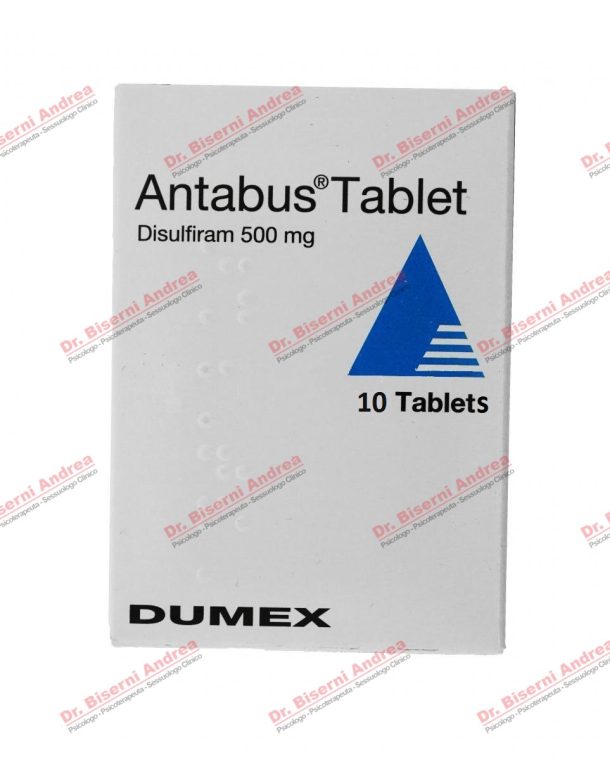
Alcoholism
Disulfiram, from about $31, and it is the one medicine in this catalogue whose entire mechanism is to make something unpleasant. It blocks aldehyde dehydrogenase, so alcohol is metabolised only as far as acetaldehyde and then stops. The result — flushing, violent nausea, racing heart, severe headache — begins within ten minutes of a drink and can last for hours.
That reaction is the treatment, not a side effect, and the deterrent only works while the tablet is actually taken. Supervised dosing produces markedly better outcomes than unsupervised, because the simplest way to drink on disulfiram is to skip it for a few days first — and the drug persists long enough that a reaction is still possible up to two weeks after the last tablet.
The hidden alcohol sources matter more than people expect: mouthwash, some cough syrups, vinegar-heavy sauces, alcohol-containing hand gels and certain aftershaves have all triggered reactions. Severe reactions can involve cardiovascular collapse, which is why it is contraindicated in significant heart disease and why it is never started in someone who is currently intoxicated.
Disulfiram does not reduce craving. It raises the cost of giving in to one. That makes it a tool inside a treatment programme with psychological support rather than a treatment on its own, and the evidence for it is strongest exactly in that combination.
Setting it up so that it works
Supervised daily dosing produces markedly better outcomes than unsupervised, because the drug’s only mechanism is deterrence and a deterrent that can be removed by skipping three days is not much of one. Supervision can be a partner, a relative, a pharmacist or a clinic, and it works best when agreed in advance as a shared arrangement rather than imposed as policing.
What disulfiram does not do
It does not reduce craving, and craving is what most people describe as the hardest part. Acamprosate and naltrexone act on that side by different mechanisms and are sometimes used alongside or instead. None of the three is a treatment on its own; the evidence for all of them is strongest in combination with psychological support, and whether that support is in place matters more than which tablet is chosen.
Before starting, and what to tell people
At least twenty-four hours alcohol-free before the first dose, liver function checked, and a clear-out of the hidden alcohol sources: mouthwash, cough syrup, alcohol hand gel, aftershave, vinegar-heavy sauces and desserts containing wine. The drug persists for up to two weeks after the last tablet, so the fortnight after stopping still carries the reaction.
Tell anyone who might treat you in an emergency. The reaction resembles several other things and the management differs.
What sobriety brings into view
Alcohol both causes erectile difficulty and medicates the anxiety about it, which makes a loop that neither a drink nor a tablet breaks. Stopping frequently reveals sexual problems the drinking was obscuring. That is a reason to have support in place, not a reason to keep drinking.
Telling anyone who might treat you
Disulfiram changes how several things are managed in an emergency, and the reaction it produces resembles a cardiac event closely enough to send treatment in the wrong direction. Carry a card or note it on your phone’s medical screen. Dentists matter particularly: some local anaesthetic preparations and many mouth rinses contain alcohol, and so do a number of liquid medicines given in hospital. Anaesthetists need to know before any planned procedure, since the drug also interacts with several agents used during surgery. None of that is a reason not to take it; all of it is a reason to say so early rather than at the point of care.
Medicines in Alcoholism